How to price second-hand clothes so they actually sell

Most clothes that sit unsold for months aren't bad clothes. They're priced off a hunch, or off the most optimistic listing the seller could find. Here's how I'd price a wardrobe clear-out or a bag of kilo-sale finds so it moves, with the fees on each app as of October 2026.
Price off what sold, not what's listed
A listing price is just someone's hope. What you want is what people actually paid, and the apps differ a lot in how much they'll tell you.
eBay is the most useful. Search for your item in the app or on the site, then tick "Sold items" in the filters, and you'll see what went and for how much. Ignore the outliers at both ends and look at the cluster in the middle. That's your price.
Depop does some of this for you. When you list, it shows a suggested price range and similar items that have sold, and lets you pick between "Likely to sell", "Balanced" and "Less likely". If you want it gone this month, take the hint.
Vinted has no sold search. You can still look up your item and sort by newest, but treat those prices as a ceiling, not a guide, because plenty of them will still be there in March.
Know what the buyer actually pays
All three apps have moved the fees onto the buyer for most people selling their own clothes, which changes the maths. The buyer sees your price plus a fee, so a tenner on the listing is never a tenner at checkout.
Vinted doesn't charge you to sell. The buyer pays the Vinted fee at checkout, which it says is usually 3% to 8% plus 30p to 80p. Bumps and Vinted's other paid promotions are optional extras, and the price list doesn't give a fixed cost for any of them, so check the figure at checkout before you pay.
Depop has no selling fee for UK sellers, but you pay 2.9% plus 30p for payment processing, on the item price and the postage. So a £20 top costs you a little under a pound, plus a few pence on the postage. The buyer pays a marketplace fee of up to 5% plus up to £1. If you boost a listing and it sells through the boost, that's another 12% in the UK on listings made since 23 March 2026.
eBay is free for UK private sellers, with 300 free listings a month. The buyer pays a Buyer Protection fee of 10p plus 7% of the first £20, then less on anything above that. On a £20 jumper that's £1.50 on top.
What this means in practice is that the fee pushes your price up for the buyer. If the sold listings say a jumper goes for about £20 all in, listing it at £20 makes it dearer than the ones that sold. Shave a bit off.
Leave room for the offer
People will offer. Price for it rather than getting cross about it.
On Vinted, buyers can offer up to 40% below your price, and you can accept, decline or counter. An accepted offer isn't binding, so the item stays up until someone actually buys it.
Depop lets you set a lowest price and respond to offers automatically: anything at or above it gets accepted, anything below gets countered at your floor. eBay's Best Offer does the same thing with an auto-accept and an auto-decline price.
My rule is to work out the lowest I'd be happy with, then list about 15% above it. Most offers land somewhere in that gap, the buyer feels they've won something, and I get my number. Set the auto-decline at your floor and you never have to reply to the 50% lowballers by hand.
Drop the price once, and properly
A listing that hasn't had a nibble in a fortnight is telling you something. Don't knock off 50p a week. Nobody notices and you look desperate.
Make one proper cut instead, and make it count. On Vinted, everyone who favourited the item gets told the price has gone down, so the people already tempted see it straight away. On Depop you can send an offer to everyone who liked it, and they get 24 hours to buy at that price. Both are better than a blind price drop, because they go to people who already wanted it.
If a cut and a fortnight still do nothing, it isn't the price. It's the photos, the title, or the item.
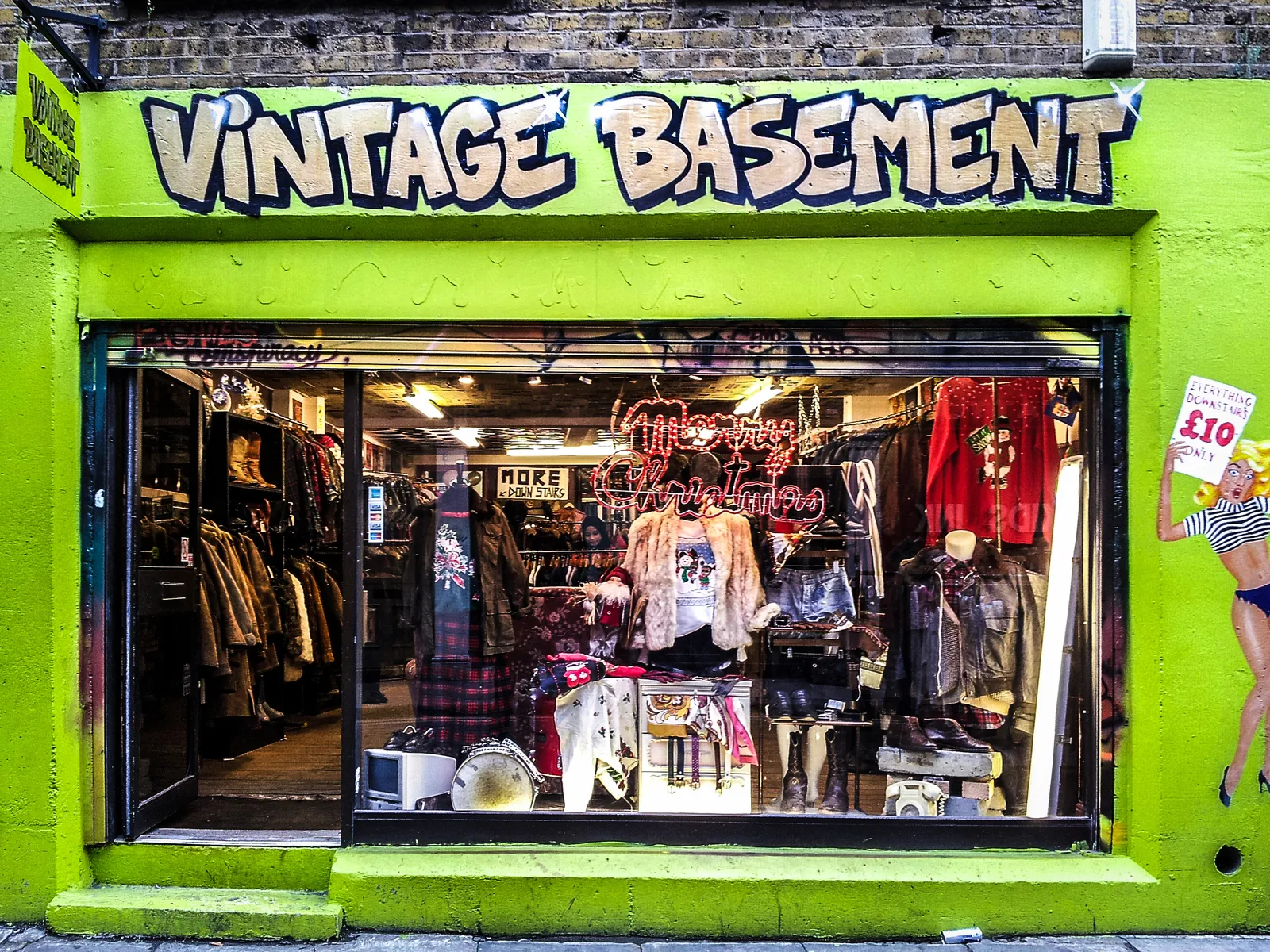
Vintage Basement on Cheshire Street, off Brick Lane, in 2012. Photo: Garry Knight, CC BY-SA 2.0, via Wikimedia Commons.
Price the cheap stuff to go in bundles
Plain high street pieces, the £3 and £4 things, barely cover the hassle of posting them one at a time. So don't try to.
Vinted lets ordinary sellers set a bundle discount based on how many items someone buys, and buyers can make an offer on a whole bundle. Turn it on, list the cheap stuff at round numbers, and let someone take five things for one lot of postage. Your good pieces don't need a discount, so keep them at full price and let the bundle do the work for the rest.
A word on the taxman
Selling your own old clothes is usually not something you pay income tax on. HMRC's guidance on selling personal possessions says as much. Buying things to sell on is different, and once that brings in more than £1,000 a year, the trading allowance runs out and you need to tell HMRC.
The apps also report sellers to HMRC once they make 30 or more sales in a year or take more than about £1,700. Being reported doesn't mean you owe anything. It just means that if you're flipping kilo-sale finds rather than clearing your wardrobe, you should keep a note of what you paid for things.